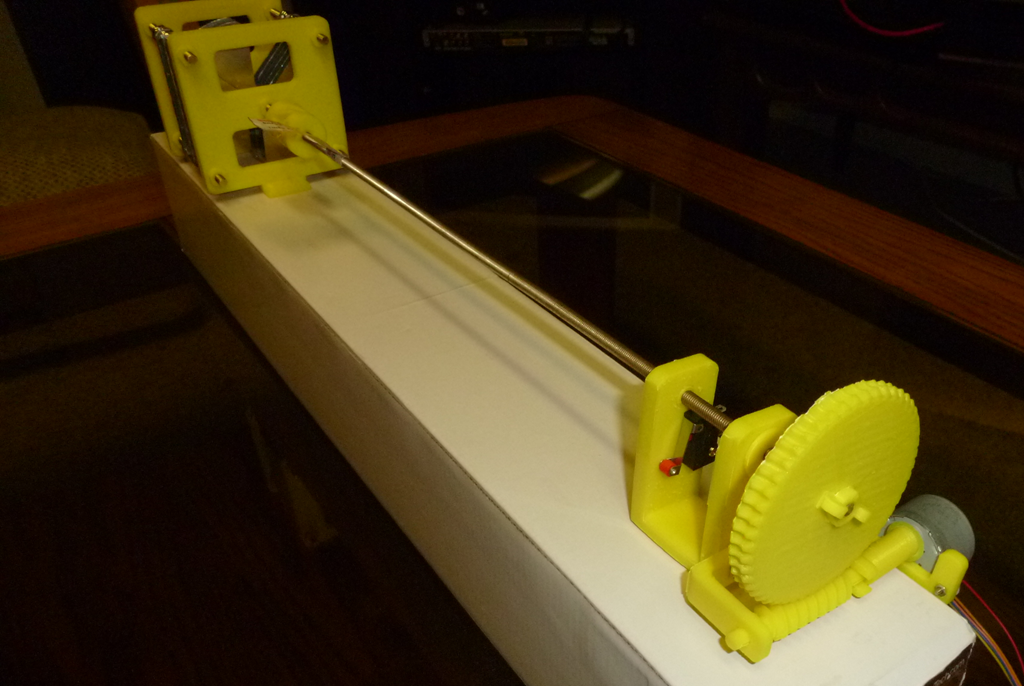
My prototype motor tuned capacitor has been assembled.
The picture above shows the butterfly capacitor (top left) and a motorized drive unit (bottom right). Perhaps this might be called a “mostly printed magnetic loop capacitor”. The parts were all designed in CAD and 3D printed with ABS plastic filament.
The drive unit for the motor tuned capacitor is separated by about 18” of brass threaded rod. The reason for the separation is to keep the motor and control electronics as far as possible from the high voltages that will be present across the capacitor.
Because the drive shaft uses a plastic coupler and other plastic parts, this should further insulate the motor and electronics from the loop antenna voltages. Time will tell. I know that ABS plastic is an insulator and has a high breakdown voltage.
Although I am able to rotate the device by hand, getting it to work with the stepper motor requires writing some software and hooking the motor up to an Arduino.
Motor Tuned Capacitor Worm Gears
Because of its design, the butterfly capacitor only has a useful turning range of 90 degrees. The stepper motor that I am using is a small cheap unipolar device with 4076 steps per revolution. If I connected this motor directly to the shaft of the capacitor, I would only have 1019 steps for turning the capacitor or about 0.09 degrees per step. I suspect this would not give me enough accuracy for the magnetic loop tuning.
So, I have built a worm gear set. Worm gears are not very efficient, but they are great for fine tuning. This one is designed to have a 50:1 ratio.
The stepper motor being used is the 28BYJ-48. This device is available on ebay for around $2-$3 complete with a driver board. It works with an Arduino and the Accelstepper library. I have played with these before and they work fine, but have not yet tried them in the presence of strong radio signals.