The wireless war started a hundred years ago. Radio made great strides during World War II with adoption, use and technological development. It offered mobility.
When the Great War started, land communications was field telephones and wire telegraphy networks. The only air-based communication was carrier pigeons. Only at sea had radio had only made its mark. Four years later, everything had changed.
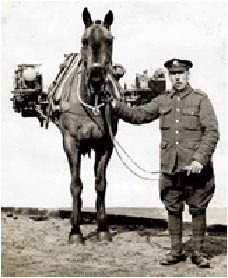
The picture above depicts mobile radio state of the art in 1914. Radios and batteries were strapped to a horse in two large boxes. The radio operator also operated the horse.
Radio was fragile, heavy and insecure. Tubes cracked or wore out. Horses and mules, and later vehicles were needed for transportation. Signals could be intercepted by the enemy. Antennas were highly visible and made easy targets. Other than for long distances at sea, few though wireless war would fare very well.
Wireless War Experimentation
Various military organizations made many advances in radio technology. For example, Major Edwin Armstrong of the U.S. Army Signals Corps developed both the regenerative and superheterodyne receivers. Other members of the Signals Corps worked with industry to develop radiotelephone, or voice communications.
Like their American counterparts, the Royal Engineers Signals Service were responsible for a whole range of communications technologies. Both services had been around for more than fifty years. Both grew rapidly during World War I with the arrival of electronic warfare and more sophisticated coordination requirements. The Canadian Signal Corps, like their brethren elsewhere, also looked after signal flags and torches, carrier pigeons and messenger dogs.
But as war became more mobile, radio proved its worth in vehicles and aircraft. Equipment got smaller, although far from miniature. Sets got more compact, reliable and easier to use. We learned how to use radio for navigation as well as communication. We learned how to operate torpedoes and dirigibles remotely over radio. All in all, the war stimulated development of new radio techniques – including FM and VHF – as well as adoption of modern tube-based sets with oscillators and amplifiers.
Taken a peek at this documentary Beyond Wires and Pigeons. Shortly, we will look at the adoption of radio on sea, land and air during World War I.