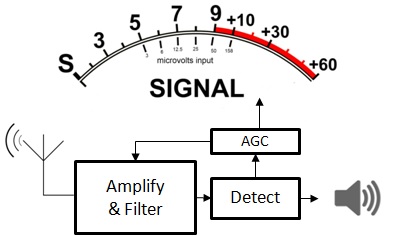
S Meters are clever approximations, not precision instruments. Remember that and you can avoid all conversations about S Meter accuracy. Read more
S Meters are clever approximations, not precision instruments. Remember that and you can avoid all conversations about S Meter accuracy. Read more

Measuring radio signals without dB would be impractical. Decibels make life simple for radio listeners. Read more

People like to measure things. So, not surprisingly, radio operators have been measuring radio signals since the early days. Read more

For shortwave listening with a software defined radio, I recommend SDR Console V3 for control, display and demodulation. Although still in development, its performance is wonderful. Read more
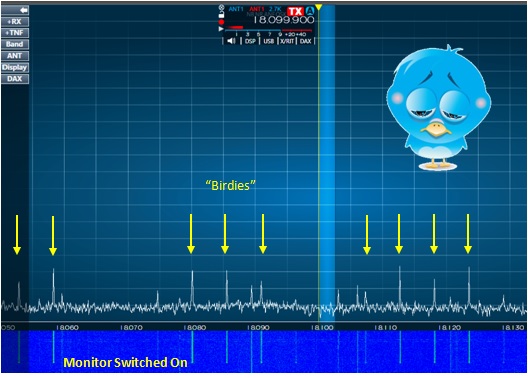
Birds are nice to have in your neighborhood but not in your radio. Computer monitors and network gear are a frequent source of RFI birdies. Read more
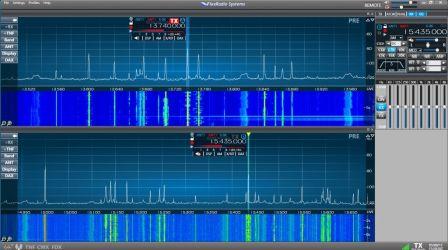
Three cheers to FlexRadio for SmartSDR software. Great job, and improving all the time. Read more
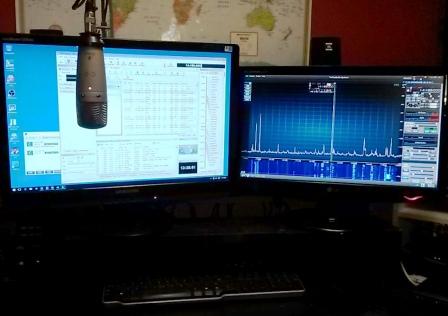
With a traditional ham radio, you sit and stare at the radio. With the Flex 6300 operating desk, you sit and stare at two computer monitors. You can’t even see the actual radio. (It’s behind the left monitor.) Read more

Using Flex 6300 connectors is a joy. They are all very standard and well laid out. This is quite different from many traditional radios. Read more
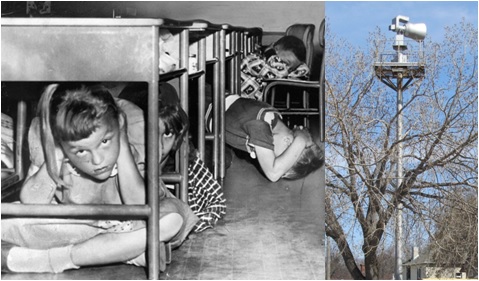
Civil defense sirens were probably the earliest form of emergency broadcasting. Are you old enough to remember the siren near your house?
When I was a kid, civil defense sirens were placed in most of our neighborhoods. I remember one just down the street. It was tested once a month. A very scary sound, especially for kids and their moms.
These civil defense sirens were part of the legacy of air raid sirens from World War II. Only during the 1950’s and 1960’s, they were meant to warn us about atomic war. Strange as it may seem today, many believed atomic war was survivable. Everyone, especially children, was taught about duck and cover. When they were first installed, there was lots of controversy about which level of government should pay to install and maintain them. Here is an interesting newspaper story about their Canadian history in Toronto.
Civil defense sirens are still used all over the world, including North America. Although here, the warning sound is more often about an approaching tornado, or a signal to alert volunteer firefighters.
Today, citizens and governments are trying to protect kids from being scared. Back then, scaring us was the best way to get out attention, apparently.
By the middle of the 1950’s, “duck and cover” gave way to “evacuate”. Wise people figured out that the best way to survive nuclear attack was to go away. In 1955, the City of Calgary conducted one of the only major civil defense evacuations ever held. Operation Lifesaver was a carefully planned warning and evacuation of northeast Calgary. It was thoroughly reported in this Operation Lifesaver documentary.
Good thing this was only a test. The first problem was the weather. Emergency officials originally planned to sound the sirens at 10:50 a.m. on September 21st. The idea was to evacuate northeast Calgary to rural locations, feed them lunch, and then send the home by early evening. Unfortunately a freak snowstorm blocked most of the highways around Calgary. As a result of impassable roads, the test was delayed until September 28th.
The second problem was low participation. Only around 6,000 of the 40,000 population actually evacuated. Most went shopping, instead. After all, it was a day off from school and work. Sigh.
Finally, there was confusion about the sirens. Most people thought the original siren was the “all clear”. For some reason, Canadian and U.S. emergency officials chose the opposite signals that people had gotten use to hearing in newsreels about the Blitz in London, England. Lots of confusion.
Honestly, I am not making this stuff up. It really happened.

My new FlexRadio needs power. With a few modifications, I can use my old ICOM PS-125 power supply. Here’s how. Read more